Monday, December 8, 2008

Removing Vanity Mirror

A Beautiful Exhibition


Students in the career of Graphic Communication Institute in Santiago Alpes contacted our group does some months to propose making a great display of origami, which would be part of their graduation project, the idea was we could show our best work and folded into a suitable room and in the best position to mount and lighting. Some of us have called "Chile Origami Masters", personally I think maybe that name too, but it can be seen in many of our best work, as the beautiful shapes in folded damp

Patrick Kunz


the original and elegant creations of Michael Kaiser


the perfect modular Beatriz Gonzalez


and many other great figures of the first level and quality. In a way, is our first show dream, we expect to maintain a tradition in the years ahead. For my part, plus some of my favorite miniatures Metallic 10x10 cm, collaborated with two large-scale figures, two models of extraordinary difficulties in its completion and require great care and patience to achieve their expressive and beautiful details: Icarus and the Buddha, both of the great master Hojyo Takashi; made pieces of paper 92x92 cm Aconcagua, these figures more than any other reflects my feelings towards this great art-craft-game.


course and enthusiastically invite all those interested to attend to a different art exhibit, first class, where you can get a glimpse of the lengths to which ordinary people can get just by playing with paper and patience, and also admire beautiful pictures full of aesthetic sense and feeling, to be come to Room 13 of the Alpine Institute in Santiago, located in Republic Street n ° 430 from this Thursday until December 11 and January 9, here I attached a map of directions, is very close to the Metro, the opening is Thursday at 19 pm. Do not miss it!

Wednesday, November 12, 2008

Nursing Student Shirts

His Majesty Square

My good friend asked me Padyta In the previous post if you can get an arbitrary angle on a sheet of paper. If we remember that a square is possible to obtain from this angle, then your question is of great importance. Motivated by this, I cheered and began to analyze the problem.

Build a line perpendicular to another two-dimensional geometry requires the use of ruler and compass and is not a simple process too. One way is by drawing a circle of arbitrary radius from a point on the line (point A) and then another from the intersection of it with the line (point B), the intersection of both circles will give us a point equidistant from both ends (C), then trace another circle with the same radius, centered at this point, and then centered to the intersection with the first (D). Thus we get the point E at the intersection of those two circles (centered at points C and D respectively), this point belongs to the perpendicular to our original line that passes by our vertex A.


However, the "origeometría" allows us to project ourselves into a third dimension and gives us real leaf as an additional element in our abilities, so if we have a straight line either, folding the paper and aligning the line on itself get perpendicular to it immediately.


Now, we achieved our angle, is it possible then to build a perfect square from both lines? The answer, fortunately, is yes, I have here a method for this.

first thing to do is build an angle of 45 ° from both lines, this will allow us to find the 45 ° line through one of our vertices arbitrarily defined. For this, we doubled our angle bisector, aligning two perpendicular lines at the point of their intersection.


then align our line of 45 ° on itself, bending it to pass through the vertex we have defined for our square. A good choice of this summit will allow us to better harness the paper and get the largest possible square from it.


In doing so, we can mark and cut one of the main angles of the square. And as we saw in the previous post, get it from the opposite angle is simple if you double the diagonal aligning it on itself.


It remains then one way to ensure a square of maximum area possible for our piece of paper. A greeting and I hope you liked it;).

Sunday, October 26, 2008

Free Go Kart Blueprints

Our friend the Square


Since the traditional origami develops from a square piece of paper the matter of achieving perfection it has become a matter of the utmost importance. Let's be honest, who has not put forward three or four demons when to start a figure we find that our beautiful leaf, taken from a taco special origami, not only is not a square perfect but not even a regular rectangle?

Throughout my years orig-mystics have used different methods to try to reconcile these "blessed" leaves with irregular results, for example if the sheet is a regular rectangle can bend the bisector of a corner, ie one of the main diagonal and intersecting it with the side of the square will give us another corner of the square.


or if our sheet has two sides perfectly parallel enough to turn a medium perpendicular to both sides, lining up the edges and then cutting the two layers at a distance (fold) equal to half the distance between sides, for this method requires a good rule, hopefully long enough to span the full width of the paper.


However, these methods fail when our road is just an irregular quadrilateral arbitrarily, as the friend who heads this post.

To find a safe way to rescue the square hidden in our paper turned to the teachings of my high school math teacher (maestro "lizard" Zuniga) who always told me: "if you build a geometric figure always returns to main feature that defines it, which gives the be ... " in this case, a rectangle, this is precisely the angles of 90 ° in each of its corners. The idea then is to create or register a 90 ° angle in a corner of our ring, what can be achieved through a square (or the corner of a sheet of copy, for example)


we cut this angle. On it you can create your main diagonal, lining one side over the other, this will be our future diagonal axis of symmetry


so, to construct the second diagonal, we replicate the right angle by folding the corner and aligning closer to itself the diagonal is our axis of symmetry, thus forming a perfect square inscribed, ready to be trimmed.


Finally it should be noted that if the registration is squarely on one side of the paper is reduced by court proceedings.

good I hope they work:) many greetings

Wednesday, July 30, 2008

Do Uncut Diamonds Look Like

This is our cry, this is our prayer: Peace the World!


Sometimes I think about how much time and energy I devote to this activity, but I repeat myself a thousand times more than a hobby it is an art form, I can not fail to consider how selfish or personal satisfaction it moves me, how much discipline, work and personal dedication to the detriment of a concern or a social perspective or directed towards others. Perhaps as a way to compensate for this conduct workshops and try to show or teach the first steps, or those figures easier to deliver (especially children) an alternative of entertainment, education and discipline.


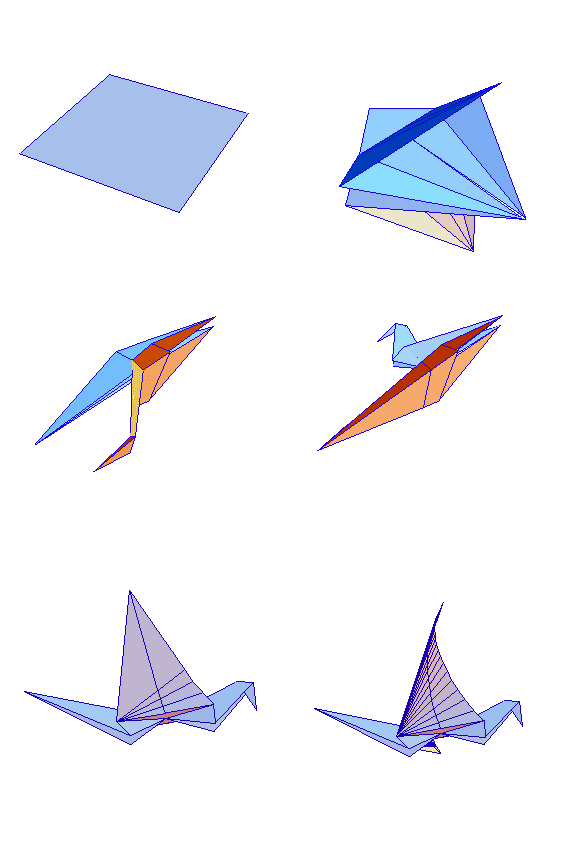
A year ago, I heard from my friend Meri Affrachino the story of Sadako Sasaki small. At the age of two years she was an inhabitant of the Japanese city of Hiroshima on 6 August of that year (1945) suffered the apocalyptic destruction of the first U.S. atomic bombs dropped in that country, that day more than 120,000 people , almost all civilians, were killed instantly and it is estimated that around 300 000 were seriously injured or seriously affected by radiation, 3 days later, 140 000 people died from the fall of the second atomic bomb on Nagasaki, in the downtown, far from their target was the Mitsubishi factory nearby. Sadako lived normally until age 11, age when she was diagnosed Leukemia due to exposure to radiation, this terrible cancerous disease quickly consumed her and left her bedridden in hospital. There he heard the traditional story of a thousand paper cranes.

Legend has it that a sick man to death did thousand paper cranes to honor the sacred bird, famous for their longevity and purity, in gratitude it healed him and gave him a long life, the tradition is that patients make this number to ask about his health. As a way to keep the hope of healing and re-run, Sadako devoted itself to doubling this figure to how much paper was on hand at the hospital and she wanted time pray for the other victims of war and peace. Unfortunately, he died on October 25, 1955 After 14 months of hospitalization, managed to make 644 cranes. It is said that their school friends dubbed the 356 missing and deposited all over in his grave with her.

Since then, every August 6, thousands of people gather and hang folding cranes in memory of Sadako and the small cry for peace and an end to the war.

For those who are dedicated to origami, turning a traditional crane is a very simple and even trivial, but do not address this example and this call is simply a sin beyond all logic and behavior. In our continent, Rosario (Argentina), thanks to the tireless Meri and his group for 9 years doing this every August 6, last year collecting more than 20,000 multi-colored cranes. This year, in Chile in Valdivia, the last weekend and met for folding and hanging cranes, and this Saturday August 2nd we will in the capital Santiago, an act that I invite all to participate, will be a moment entertainment and color, in the Plaza del Barrio Bellavista Mori, exactly at noon, there will be workshops on origami and will join the cry that is written on the memorial of Sadako:

"This is our cry, this is our prayer: Peace in the World! "

I look forward to visiting my friend in Rosario and work with something in the meeting this year.

Greetings to all.


Links: Call
Thousand Cranes for Peace Santiago, Chile, August 2 (Facebook). Project
Thousand Cranes for Peace Rosario Argentina, August 6

Sadako.com Project Making a crane


Saturday, May 24, 2008

Hole In The Heart Games

Haga Theorems (Part I) Perfect


ago few months when I got into the topic of Ken Miura Robert Rose Lang had the courage to write an email, to show my poor resolution of the CP of this beautiful rose, which is already charted in the book of the annual convention of Origami USA 2007, as well as in the book of the 12th Convention JOAS , and his answer filled me with joy, not only allowed me to publish my poor doc but also gave me suggestions and good advice.

One of these suggestions was the Junior version of the Miura Ken Rose, described by him as the construction of a grid of horizontal divisions in 12/54, 25/54 and 39/54, each of which then divided to half, along with vertical divisions of 1 / 9 each. Then I was faced this issue of the divisions a little strange at first sight a little fanciful, because who in full possession of his mental faculties could be made up to half turn 54: D? The thing is not so obviously, if we consider that 6 / 54 are 1 / 9 and twice that make the first of the horizontal divisions suggested by Master Lang. Moreover, if we divide the paper in these units of 6 / 54 (or 1 / 9), 6 units and complete the 39/54 half of the bottom, and split one of those units to half do not sound so terrible.


So how consegumos 1 / 9 folding a sheet of paper? Quite a problem, if I can say. The search for an answer led me to Theorems Haga, beautifully described on the website of the Japan Origami Academic Society , by someone identified as Koshiro. The idea then now is to show how they work and how they base their results.

Right The First Theorem says something like: "If we take a corner of a square to a torque division mark on the opposite side, indicating an uneven division known in its adjacent side." To visualize take the simplest case of dividing a hand in two and take the opposite corner to it, and see that we get the other side.


As we see, gives an indication of 2 / 3 on the right side of this square. The explanation comes from the world of mathematics (what else?), The triangles are related to SAP and PBT, are said to be "like" or proportional, ie the second is like the first but proportionately larger, demonstration of this is the interior angles, there is a classic theorem of geometry (and here I use the word "classic" to excuse not to show it:)) which says that if a triangle has each of its sides perpendicular to the sides of other then the interior angles of both triangles are equal and therefore they are proportional, or similar. In this case it is clear that the SA side is perpendicular to PB (line segment AB), the AP side is perpendicular to BT and it's SP for PT.

Then SA = c * PB, AP = c * BT and SP = c * know PT and AP = PB = 1 / 2 and SA + SP = 1, we know how BT measured. If the triangles are proportional, AP / SA = BT / AP

PB / SA = BT / (1-AP) or (1 / 2) / SA = BT / (1 / 2) and BT = 1 / ( 4 * SA)
SA
how much better then? By Pythagoras we know that


and hence SA = (1-1/4) / 2 = (3 / 4) / 2 = 3 / 8

and BT = 1 / (4 * 3 / 8) = 1 / (3 / 2) = 2 / 3

However, in the general case we


generating the following table, which could be our workhorse when it comes to creating arbitrary divisions grids :


in a future entry may look at other ways exist for these divisions, known as the Second and Third Theorems Haga, if there is interest, of course: P

many greetings ...

Tuesday, May 20, 2008

How Do Get Thyroid Cyst

Poleras


Our products can be purchased in person at the Bio-Bio region (only province of Concepción). For more information on prices or payment email: @ accesoriosremolinodepapel

gmail.com or visit our flog
http://www.fotolog.com/r_d_p_accesorios


Goodbye

Friday, May 16, 2008

2009 Honda Ridgeline Rearview Camera Installation

Remolina Paper


Our products can be purchased in person in the region of Bio-Bio (Concepción province only). for more information on pricing or payment email:


or visit our flog


Thursday, May 15, 2008

Specialized Dolce Comp Weight

Remolina Paper


How to buy?


Our products can be purchased in person at the region bio - bio , province of Concepción Chile. agreeing to an appointment, which personally delivered the required products.
For more pricing information write us at:
Bye.